



Tip & Advice
DIY Solar Roof Ventilation Systems
DIY solar roof ventilation refers to solar-powered roof ventilation designed for homeowners who are…

Solar battery rebates are a key reason why homeowners across Australia are choosing solar storage now. With federal incentives, installing a solar battery has never been more attractive for lowering power bills, increasing energy independence, and taking control of your energy future.
If you’ve been tracking solar battery rebates in Australia, you’ll know the Cheaper Home Batteries Program (federal government) has been a game-changer since its launch. Under this scheme, eligible batteries attract a discount through Small-scale Technology Certificates (STCs) which are essentially tradable certificates that fund part of the battery cost at the point of sale.
For 2026, there are important updates to how these rebates are calculated compared to 2025 especially around the STC factor and how rebates are applied based on battery size.
Lock in your battery rebates before they drop
Solar battery rebates are expected to reduce again soon. Explore our current battery deals and secure your rebate.
The STC factor determines how many certificates a battery earns per usable kilowatt-hour (kWh), which directly influences your rebate value.
In 2026:
This means that the later in the year your battery is installed, the fewer STCs it will earn and the smaller the rebate value will be. The installation date is what counts, so timing can make a big difference.
Another major change from 1 May 2026 is how rebates are tiered by battery size. Rather than applying the STC factor equally across all battery capacities, the new rules use bands making smaller systems relatively more valuable under the rebate:
Battery Size (usable kWh) & Rebate Tiers
In simple terms, the first 14 kWh of your battery gets the full rebate value. Any capacity above that receives a reduced percentage, meaning larger batteries will attract less support per kWh added. This change is aimed at keeping incentives proportionate as battery costs fall and ensuring continued support across typical household systems.
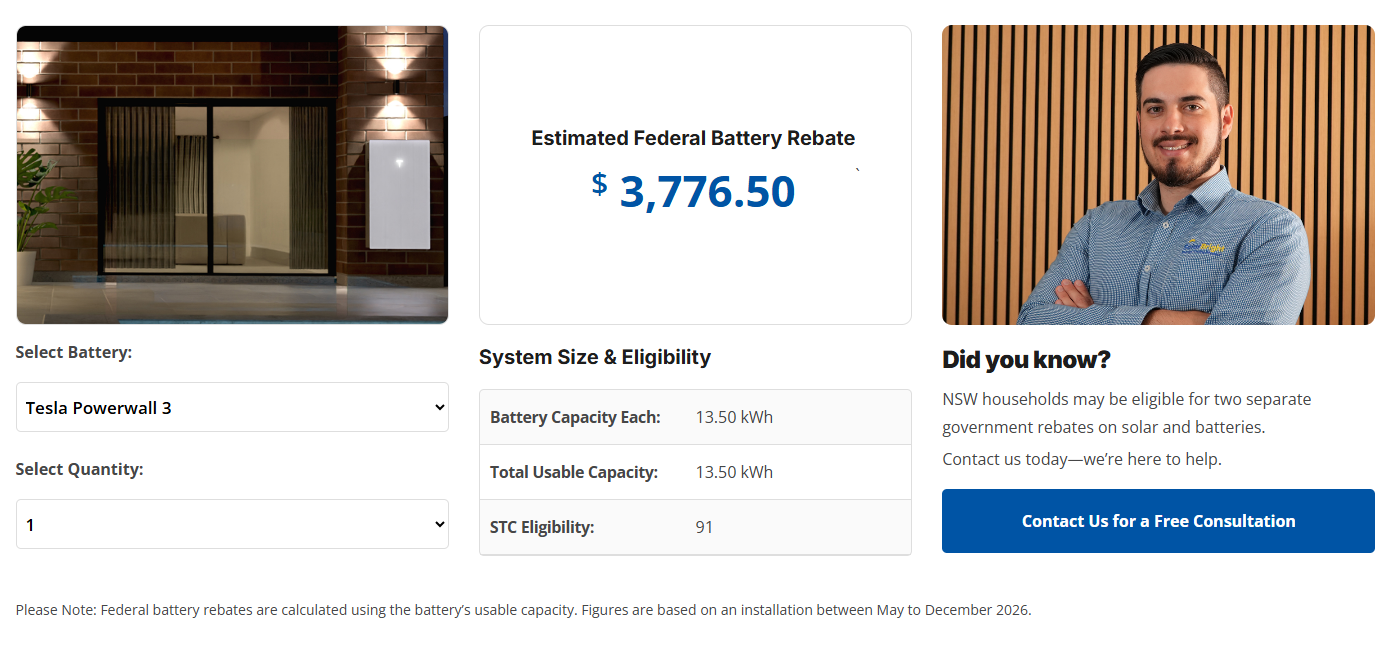
Want to see exactly what this means for your own system? Check out our Solar Battery Rebate Calculator we’ve built it to reflect the May–December 2026 settings so you can plan ahead with transparency.
As of now, no further changes are expected for the rest of 2026 according to current government modelling and our rebate calculator. This gives you a stable framework to plan with.
However, more adjustments are forecast for 2027, with the STC factor continuing to reduce every six months and potentially further tweaks to how rebates are applied through to 2030. That means delaying your install could significantly reduce your rebate. So if you’ve been on the fence, acting now could save you money.
Don’t delay – act now to secure the best rebate possible.
To take advantage of solar battery rebates:
Rebates won’t last forever.
Getting your solar battery now not only lowers your upfront cost, it speeds up your path to energy independence, reducing reliance on the grid and lowering power bills over the long term.
Understanding rebates, STCs, battery sizing, and timing can be overwhelming especially when the rules are changing. That’s why we offer a Free Consultation to help you:
Book your free solar battery consultation today.

Take a Look
Tip & Advice
DIY solar roof ventilation refers to solar-powered roof ventilation designed for homeowners who are…
News
SolarBright has been recognised with Tesla Powerwall Premium Certified Installer status, reflecting our installation…
Solar Power Tips
Traditional skylights can be a great way to bring natural daylight into your home.…